

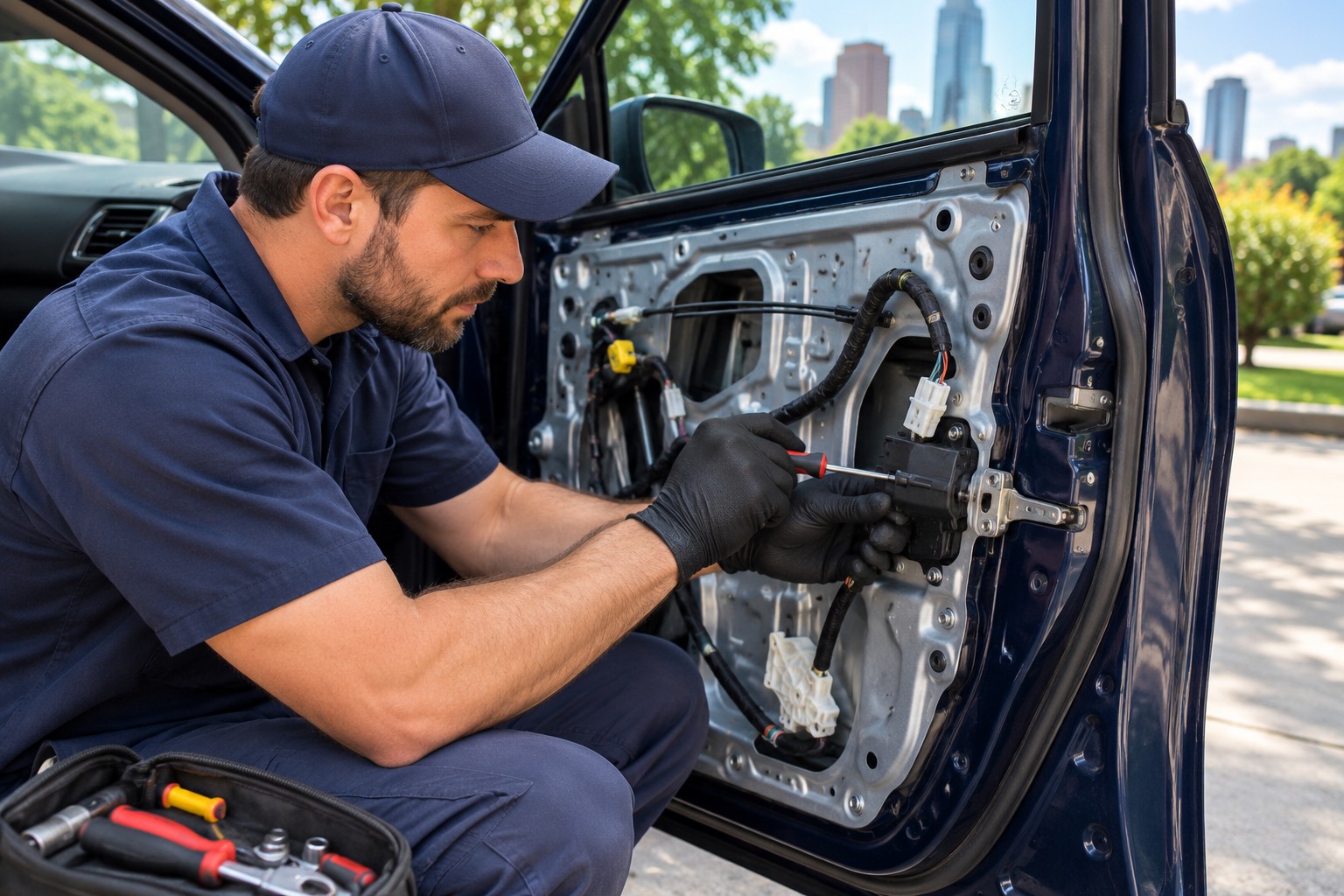
Car door lock actuator replacement in Houston becomes necessary when one door stops responding to the key fob or interior switch while every other lock still works. The actuator is the small motor and gear assembly inside the door that physically moves the latch, and it wears out from heat, moisture, and years of daily use. Express Locksmith sends a licensed mobile technician to diagnose and replace a failing actuator where your car is parked, with upfront pricing and 24/7 availability.
How Much Does Car Door Lock Actuator Replacement Cost in Houston?
Car door lock actuator replacement in Houston typically costs between $200 and $600, with parts running $50 to $300 and labor adding $150 to $300. The final number depends on your vehicle and how hard the door panel is to open.
For a Houston reference point, the RepairPal Fair Price Estimator estimates $465 to $592 for a 2024 Chevrolet Silverado 3500 HD, with about $192 in parts and $273 to $400 in labor. Labor made up roughly 68% of that total, which is typical: the part is inexpensive, and the time spent removing the panel, testing the circuit, and reassembling the door is what you pay for. Luxury and newer vehicles can exceed the usual range, as the chart below shows.
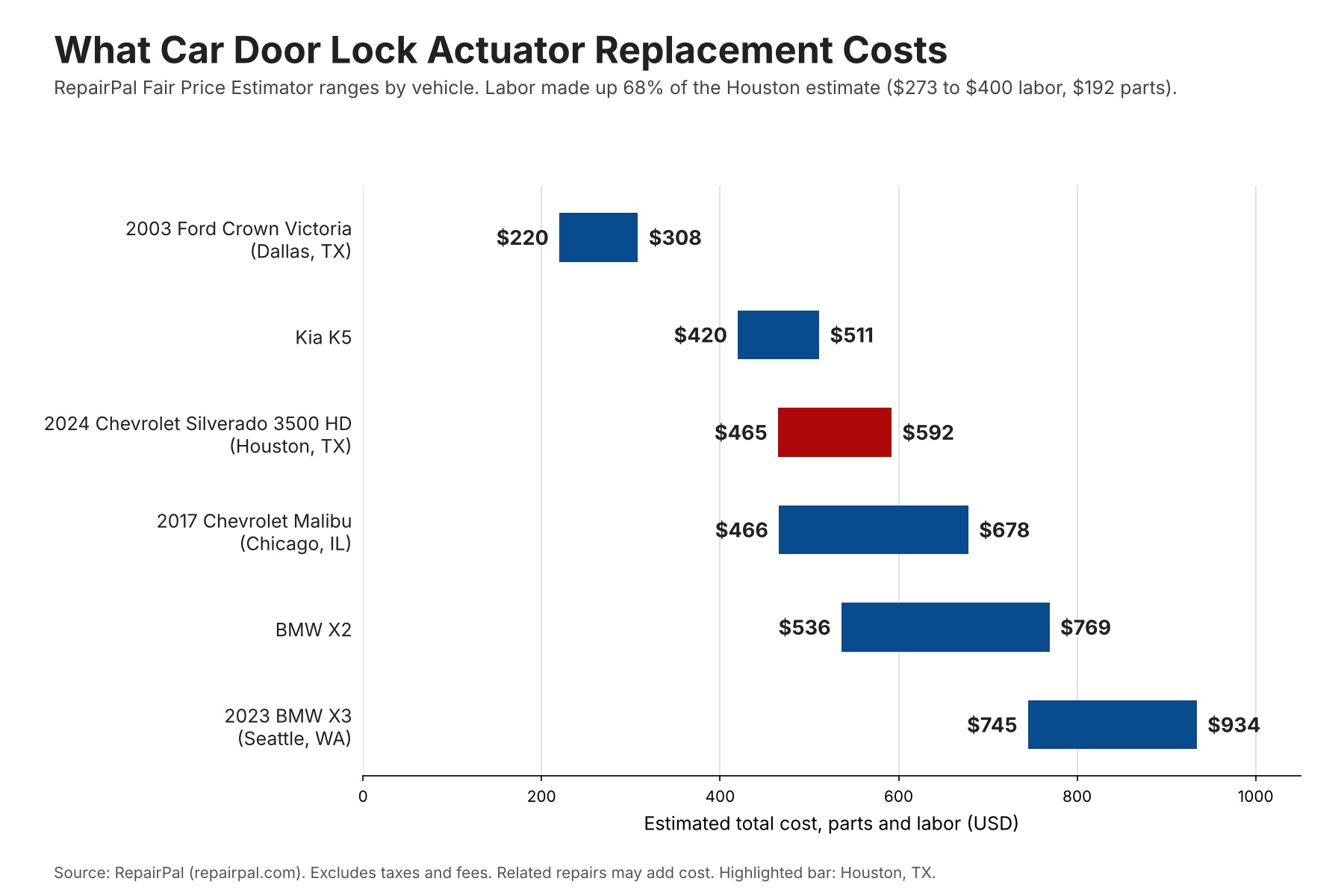
Source: RepairPal Fair Price Estimator estimates (Houston highlighted in red). Ranges exclude taxes and fees.
| Cost item | Typical range | What drives it |
|---|---|---|
| Actuator part | $50 to $300 | Vehicle make, model, and whether the actuator comes as part of a latch assembly |
| Labor | $150 to $300 | Door panel complexity, wiring access, and testing time |
| Total replacement | $200 to $600 | Higher for luxury, newer, or integrated-assembly designs |
| Houston example (Silverado 3500 HD) | $465 to $592 | About 68% labor, 32% parts, per RepairPal |
Car Door Lock Actuator Replacement Cost Factors
Five factors move the price up or down, and knowing them helps you compare quotes fairly.
- Vehicle make and model: European and luxury brands carry higher part and labor costs than most domestic and Asian models.
- Integrated assemblies: some vehicles combine the actuator and latch into one unit, which raises the part price.
- Door panel layout: on some vehicles the window and regulator must come out to reach the actuator, which adds labor.
- Accurate diagnosis: testing the circuit first prevents paying for a part that was never the problem.
- Number of failed actuators: older vehicles sometimes need more than one replaced around the same time.
For other service costs, see the published service pricing for common locksmith jobs.
Mobile Locksmith vs. Dealership vs. DIY
A mobile locksmith is the fastest route when the lock fails away from home, because the repair happens at your location.
| Option | Where the repair happens | Best for | Watch out for |
|---|---|---|---|
| Mobile locksmith | Your driveway, workplace, or roadside | Fast diagnosis and same-visit replacement | Confirm upfront pricing before work starts |
| Dealership or shop | Their service bay | Warranty work and complex integrated systems | You bring the car in and may wait for an appointment |
| DIY | Your garage | Experienced owners with the right tools | Airbag connectors, broken panel clips, and misdiagnosis |
What Is a Car Door Lock Actuator and How Does It Work?
A door lock actuator is an electric motor and gear assembly inside the door that converts a signal from your key fob or door switch into physical lock movement. Every power-locked door has one, and they cycle every time you lock or unlock the car.
The command travels from the key fob, interior switch, or automatic speed-lock through the body control module, down the door harness, and arrives at the actuator as an electrical pulse. The motor drives a set of reduction gears that turn rotation into linear motion, pushing or pulling a rod that engages or releases the latch. Because the actuator is part of the vehicle’s security system, a weak one affects more than convenience: it determines whether your doors stay locked at highway speed. Our car lock and key services cover this repair along with lockouts, key replacement, and ignition issues.
Door Lock Actuator Symptoms: 6 Signs of a Bad Actuator
The most common door lock actuator symptoms are clicking or grinding inside the door, slow lock movement, intermittent operation, and one door that ignores electronic commands while the others work.
Symptoms rarely arrive all at once. The first sign is often a lock that needs two or three presses to engage. Intermittent failure is easy to dismiss, since the lock may work for a week, fail on a cold morning, then recover, but that inconsistency is itself a clue. Ignoring it shortens the road to complete failure, which can leave a door permanently unlocked or trap a passenger.
| Symptom | What you notice | Likely cause |
|---|---|---|
| Grinding, clicking, or whirring | Noise from the door panel when you press lock | Worn or stripped internal gears |
| Sluggish operation | Plunger moves slowly or stops short of full travel | Weak motor or worn gears |
| Intermittent function | Works some days, fails on others | Corroded contacts or loose wiring connection |
| Single door ignores commands | Other doors lock and unlock normally | Failed actuator or broken wire in that door |
| Buzzing with no movement | Motor spins but the lock does not move | Stripped plastic or nylon gears |
| Battery keeps dying | No obvious cause for repeated drain | Actuator switch stuck closed, drawing constant current |
If you recognize any of these, skip the guesswork. Technicians Aaron and Leon come to you for an on-site check with upfront pricing, and you can contact the team to have one dispatched.
“Super friendly and streamlined services. Aaron arrived before his estimated arrival time and handled his business with professionalism. I was very pleased with his business and will recommend to anyone in need. Cheers!” (Zachary Zahn)
Mechanical vs. Electrical Door Lock Actuator Failure
Mechanical failures involve stripped gears or bent linkage and almost always make noise, while electrical failures involve power loss and are usually silent.
| Type | What happens | What you will notice |
|---|---|---|
| Mechanical failure | Plastic or nylon gears strip, or linkage bends | Loud clicking, whirring, or grinding; plunger moves partially; manual lever works smoothly |
| Electrical failure | A fuse blows, a wire cracks or corrodes in the door hinge boot, or the motor coil burns out | Complete silence; plunger does not move; manual lever may feel stiff if the motor is seized |
The gears inside most actuators are plastic or nylon, chosen for weight and cost rather than longevity. After years of constant cycling, they slip or strip. The motor keeps spinning, so you hear a buzz, but nothing moves. Electrical faults need a multimeter to trace voltage from the fuse box through the door harness to the actuator, which is why guessing often leads to replacing a part that was never the problem.
Why Forcing a Stuck Door Lock Costs More
Forcing the lock plunger when the motor is seized can bend the linkage or snap the latch assembly, turning a simple actuator replacement into a larger door repair. If the lock resists, stop and get it tested.
Why Houston Heat and Humidity Shorten Actuator Life
Houston’s heat and moisture wear out actuators faster than milder climates because the plastic gears expand and contract with every temperature cycle, lubricants break down, and contacts corrode.
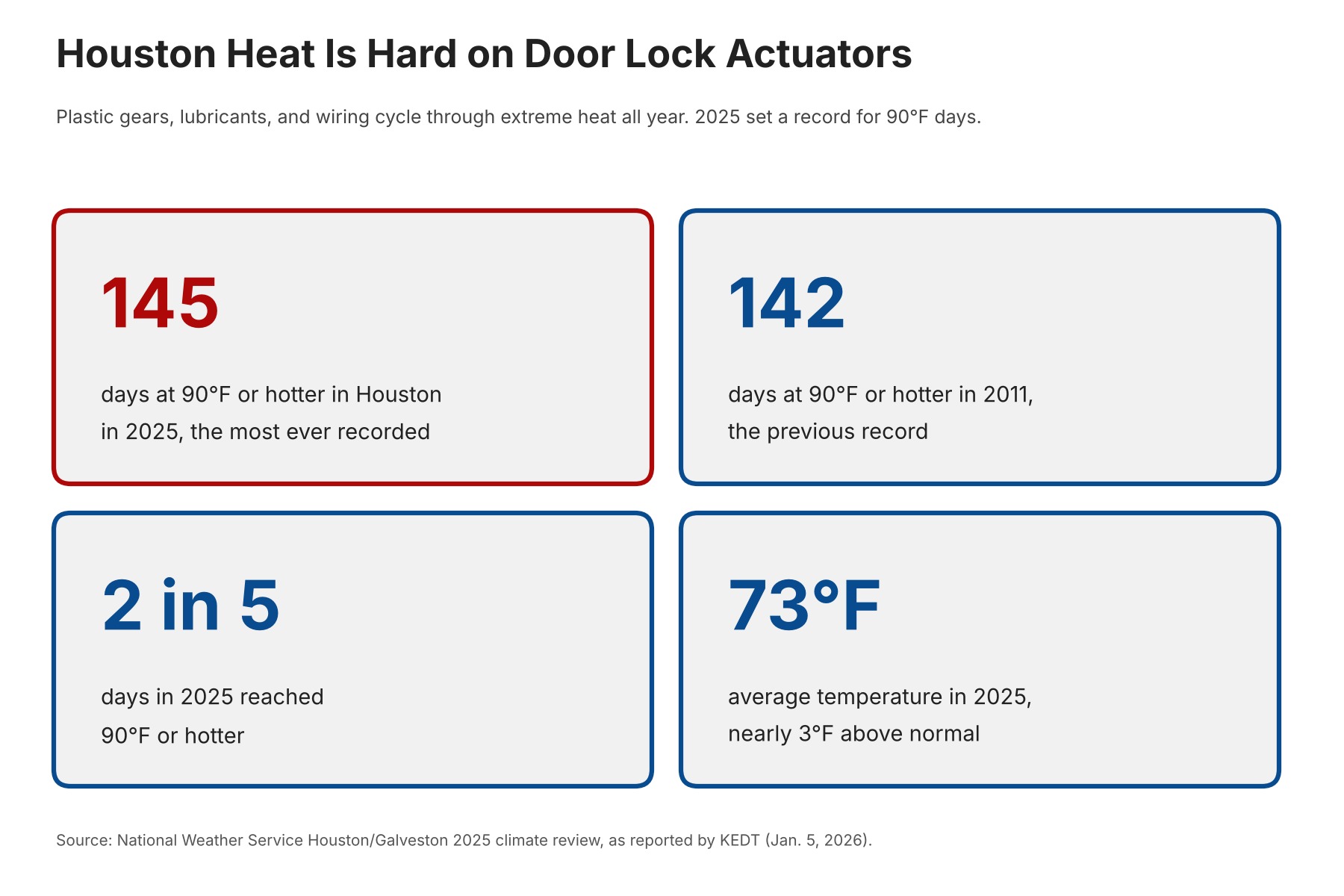
Source: National Weather Service Houston/Galveston 2025 review as reported by KEDT.
The National Weather Service counted 145 days at or above 90 degrees in Houston during 2025, beating the previous record of 142 set in 2011. Thermal fatigue weakens gear teeth and housings over the years, and coastal humidity corrodes electrical contacts, sometimes causing a sudden short that kills the motor with no warning. A lock that worked Monday can be dead by Friday. Heavy daily use speeds this up, so family vehicles, rideshare cars, and fleet trucks tend to show actuator problems sooner than lightly driven cars. Frequent door slamming adds wear to the linkage too.
Drivers in Aldine, Humble, Spring, Tomball, Conroe, and The Woodlands deal with the same conditions. See the full list of communities across Houston, Spring, Conroe, and The Woodlands we serve with on-site mobile service.
How to Diagnose a Bad Door Lock Actuator
Diagnosis starts by isolating the failure to one door. When only one lock fails while the others respond to the fob and switches, the fault almost certainly lies with that door’s actuator or wiring, not a central fuse, the body control module, or a weak fob battery.
- Rule out the key fob: Replace the fob battery or try your spare fob. If every door ignores the fob but the interior switch works, the fob is the problem, not an actuator.
- Isolate the door: Check whether other doors have the same issue. If all doors are dead at once, inspect the central locking fuse before blaming an actuator.
- Test every input: Lock the door with the key fob, the interior switch, and the physical key. A door that fails all three points to its actuator or wiring.
- Listen at the door panel: Press the lock button with your ear near the panel. Whirring or clicking with no lock movement suggests stripped gears. Silence suggests an electrical fault.
- Check manual operation: Move the lock plunger by hand without forcing it. Smooth movement means the linkage is fine. Stiffness suggests a seized motor.
- Follow your owner’s manual reset: Use the central locking reset steps for your exact make and model. Procedures vary, so skip generic sequences that may create new faults.
Step one matters more than most drivers expect: fob battery and programming support can rule the fob in or out before anyone opens a door panel.
Blown Fuse vs. Bad Actuator
A blown fuse kills every door lock at once, while a bad actuator kills one.
| Check | Blown fuse | Bad actuator |
|---|---|---|
| Doors affected | All doors stop responding together | One door fails, others work |
| Sound | Silence from every door | Grinding or buzzing, or silence from one door |
| First test | Inspect the central locking fuse | Test fob, switch, and key on the failing door |
Why You Should Not Pull the Door Panel Yourself
Behind the trim sits the wiring for the window regulator, mirrors, and lock switch, and many vehicles also route a side-impact airbag sensor through the door. Yellow SRS connectors need special care, because disturbing them can set fault codes that require specialized equipment to clear or, in the worst case, risk unintended deployment. Panel clips are single-use on many designs, and prying without the correct tools breaks them for good, leaving a permanent rattle.
Can You Drive With a Bad Door Lock Actuator?
You can drive the car, but you must lock the affected door by hand before moving, and the door may stay unlocked when parked. RepairPal notes that a failed actuator does not affect how the vehicle drives, but an unsecured door still leaves your belongings exposed and creates a hazard if a passenger needs to exit quickly. It will not fix itself, and delay tends to turn a single repair into several.
When to Call a Mobile Locksmith for Actuator Repair
Call a mobile locksmith as soon as a lock sticks, grinds, or fails twice in a week, because a non-working lock means an unsecured vehicle. Express Locksmith is a licensed locksmith serving the Houston metro area 24/7, and the team comes to your location with the tools to test, replace, and verify the repair on the spot. If you are already locked out, get emergency lockout help right away instead of waiting.
The shop is at 14106 Stuebner Airline Rd Suite B, Houston, TX 77069, and mobile service covers Spring, Conroe, Tomball, Aldine, Humble, The Woodlands, and surrounding communities. No waiting at a shop, no hidden fees.
Call (832) 690-1640 Get a Free Quote
Frequently Asked Questions About Door Lock Actuators
How much does it cost to replace a door lock actuator?
Replacing a car door lock actuator usually costs $200 to $600. Parts generally run $50 to $300 depending on the vehicle, and labor adds $150 to $300 depending on how hard the door panel is to access. Vehicles with integrated actuator and latch assemblies, or tight panel layouts, land at the higher end.
Can I drive my car with a broken door lock actuator?
Yes, the vehicle still drives, but the affected door may stay permanently locked or unlocked. An unlocked door leaves the contents of your car exposed, and you will need to lock that door by hand before you drive. Repair it soon rather than waiting for the problem to resolve itself.
What is the difference between a blown fuse and a bad actuator?
A blown fuse usually cuts power to the whole central locking system, so every door lock stops working at once. A bad actuator affects only the single door where the motor or gears failed. If one door is dead and the others respond normally, the fuse is almost certainly not the cause.
How long do car door lock actuators last?
Most door lock actuators last 8 to 12 years of regular use. Extreme heat, high humidity, and frequent door slamming can shorten that. Houston’s long hot season and coastal moisture mean actuator problems often show up earlier than the manufacturer’s general expectation.
Can a bad actuator drain my car battery?
Yes. If the actuator’s internal switch fails in a closed position, it can pull a continuous parasitic load from the electrical system. That slow drain can leave a battery dead overnight, especially in an older vehicle. If your battery keeps dying without an obvious cause, have the door lock actuators checked along with the usual suspects.
Why is only one of my car door locks not working?
When one door fails and the rest respond to the key fob and interior switches, the fault is almost always that door’s actuator or its wiring, not the fob, the fuse, or the body control module. Testing the lock with the fob, the interior switch, and the physical key helps confirm it.
Can a locksmith replace a car door lock actuator at my location?
Yes. A mobile locksmith can diagnose the failure and replace the actuator where your car is parked, at home, at work, or on the roadside, so you do not need a tow or a day at a shop. Express Locksmith technicians serve the Houston metro area 24/7 with upfront pricing.
Is it safe to replace a door lock actuator myself?
It is risky. The door panel hides the wiring for the window, mirror, and lock switch, and many vehicles include side-impact airbag connectors. Disturbing those can set fault codes or trigger deployment, and many panel clips break if removed without the right tools. A misdiagnosed DIY repair often costs more than a professional visit.