

Can a worn key damage a lock in Houston? Yes, and the damage is usually so gradual that most people only notice when the key finally refuses to turn. It starts with a small change: you pull the key back a hair, tilt it slightly, or jiggle it until the cylinder gives way. The door still opens, so the habit sticks. Meanwhile, every one of those little adjustments grinds metal against metal inside the lock.
The good news is that a worn key is one of the cheapest lock problems to fix when it is caught early. A fresh key costs a fraction of a new cylinder, and both cost far less than an emergency service call after a key snaps off at night. This guide explains what a worn key does inside a lock, how to spot the warning signs, how to run a simple spare key test, and when it is time to call a professional.
Can a Worn Key Damage a Lock Cylinder Over Time?
A pin-tumbler lock, the type found on most front doors and deadbolts, depends on precision. Each cut on the key blade, known as the bitting, is machined to a specific depth. Those depths match the pin stacks inside the cylinder. When the key goes in, each cut lifts its pin stack to exactly the right height, the pins line up along the shear line, and the plug can rotate. Even small errors in that geometry change how the lock behaves.
How a Key and Cylinder Work Together
Think of a key and its cylinder as a matched set. The key is designed to move the pins to precise positions with almost no force. When both parts are in good shape, turning a key feels smooth and effortless. Year after year of daily use slowly rounds off the sharp edges of the bitting, and the key starts to lift pins a little less accurately. The lock does not break right away. Instead, it asks the key to do more work, and you supply that work by pushing, pulling, and wiggling.
For homeowners, that matters most on the doors used every day: the front door, the garage entry, and the back door. If one of those locks is starting to feel stiff, an inspection and home lock service can sort out whether the key, the cylinder, or both need attention.
What Worn Bitting Does Inside the Cylinder
Once the key no longer seats the pins at the right height, several problems build on one another. None of them is dramatic on its own, which is exactly why they go unnoticed.
Pin and Plug Wear
A key that lifts pins unevenly drags them across the edges of the plug as it turns. Brass is a soft metal by design, which makes precise manufacturing possible, but it also means repeated friction wears the pins and the inside of the plug faster than normal operation would.
Metal Debris and Added Friction
Wear produces fine metal particles. Those particles settle into the pin chambers and around the springs, where they create a gritty film that slows pin movement. A gritty cylinder needs more force from the key, and more force produces more debris. The cycle feeds itself.
Stress on the Key Itself
The key is not an innocent bystander. When you twist a worn key harder to get a stubborn cylinder to turn, you flex a thin brass blade that was never meant to act as a lever. Small bends and hairline fatigue develop along the shaft, and the blade becomes more likely to break at the weakest point.
Why Houston Humidity Makes Key Wear Worse
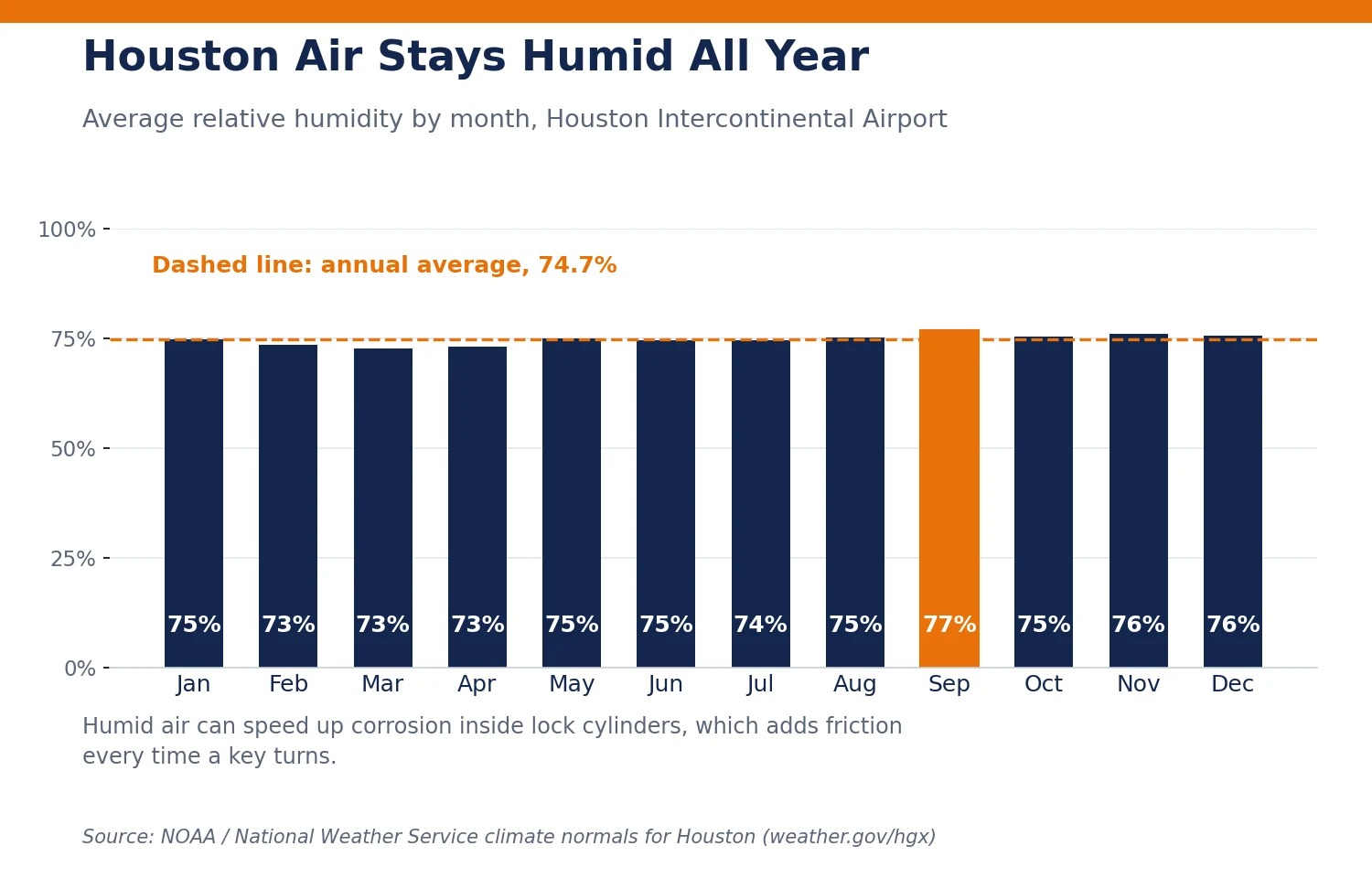
Local climate adds a second layer of stress. According to NOAA data for Houston, relative humidity at Houston Intercontinental Airport averages roughly 75 percent across the year, and no month drops far below that. Constant moisture can speed up corrosion on metal parts and mix with dust and lint inside a keyway, which increases friction on every turn. A worn key forcing its way through a cylinder that is already fighting humidity wears the lock faster than either problem would alone.
Around Cypress, Spring, Humble, and The Woodlands, the pattern is the same. At Express Locksmith, technicians see the effects most often on exterior locks that face weather, such as front doors and side gates, where moisture and dust reach the cylinder every day.
Warning Signs Your Key Is Wearing Out
Key wear shows up in two ways: what you can see and what you can feel. Checking both takes less than a minute and can save you from a lockout.
What to Look For and What It Means
| Sign | What it usually means | How urgent it is |
|---|---|---|
| Rounded or shiny teeth | The sharp edges of the bitting have worn smooth from metal-on-metal contact | Replace soon |
| Thin spots or deep scratches along the blade | Material has been lost to friction, so the cuts are no longer to specification | Replace soon |
| A bend or twist in the blade | The key has been forced, and stress is now concentrated at one point | Replace right away |
| Needing to jiggle or pull the key back | The bitting is no longer seating the pins at the correct height | Test with a spare this week |
| Scratchy or catching feel on insertion | Friction in the keyway from wear, debris, or both | Have the lock inspected |
| Key sticks only in humid or rainy weather | Moisture is adding friction to a cylinder that is already marginal | Have the lock inspected |
Car keys wear the same way. If your ignition key turns roughly or needs wiggling, a technician offering car key service can check both the key and the ignition cylinder before one of them fails.
Can a Worn Key Damage a Lock Even If It Still Turns?
Yes. A key that still turns the cylinder is not necessarily a healthy key. The lock may open only because you are compensating with extra pressure, and that compensation is the part that causes damage. If you have to use a trick to make a key work, whether that is a tilt, a half-pull, or a firm push, the key is already outside the lock’s tolerances. Treat that as an early warning rather than a quirk to live with.
The Spare Key Test: Is It the Key or the Lock?
You do not need tools to find out where the problem lives. A spare key that rarely gets used gives you a clean comparison.
How to Run the Test
- Find a spare key that has seen little use, such as one kept in a drawer rather than in a pocket.
- Insert it slowly into the lock that has been giving you trouble.
- Turn it with normal pressure, without jiggling or pulling it back.
- Note whether it turns smoothly, drags, or catches.
How to Read the Results
| Result | What it tells you | Best next step |
|---|---|---|
| Spare turns smoothly, main key does not | The main key is worn and the lock is still in good shape | Replace the main key with a fresh cut from the lock’s specifications |
| Both keys stick or grind | The cylinder has picked up wear, debris, or corrosion | Professional inspection and cylinder service |
| Both keys are rough, and one is bent | Forcing has damaged the key and may have stressed the pins | Replace the keys and have the cylinder checked |
| Neither key works | Pins may be damaged or the lock may be seized | Call a locksmith before forcing anything |
If the test points to the cylinder, the fix is often less drastic than a full replacement. A technician can service the cylinder, or recommend re-pinning the cylinder to a new key when the internal parts are worn but the lock hardware is sound.
Why Copying a Worn Key Makes Things Worse
This is the most common mistake people make. A worn key goes to a self-service machine, a duplicate comes back, and the lock still sticks. The reason is simple. A duplicating machine traces the key it is given, so a worn original produces a worn copy. The new key may look shiny and fresh, but its cuts carry the same errors as the old one, and it wears the lock in the same way.
Copying a Key vs. Cutting a Key by Code
| Copying a worn key | Cutting a key by code | |
|---|---|---|
| Starting point | The shape of the worn blade | The lock’s factory depth specifications |
| What gets repeated | Rounded cuts and off-spec depths | Nothing from the old key |
| Effect on the lock | Same friction and wear as before | Clean pin alignment as designed |
| Best used for | Healthy keys in good condition | Worn, bent, or heavily used keys |
Cutting by code requires the right key code or a way to determine it from the lock, which a trained technician can usually do on site. If you want a worn key restored to factory dimensions, ask about cutting a replacement key from original specifications.
What a Quality Key Cut Includes
- Accurate depths: each cut matches the specification for its position on the blade.
- A good blank: a solid brass or nickel silver blank resists bending better than a cheap or worn one.
- Deburred edges: removing the tiny burrs left by cutting lets the key slide in without scraping the keyway.
- A test in the lock: the key is checked in the actual cylinder before you leave.
What Happens When You Force a Worn Key
When a key resists, the instinct is to push harder. That is the moment most small problems become expensive ones. Brass bends under stress that steel would shrug off, so a forced key flexes, and a flexed blade has a weak point. If it snaps, part of the key stays inside the cylinder.
Why a Broken Key Costs So Much More Than a New One
A key that snaps off in a scored cylinder can turn a five-minute key replacement into a lockout, an extraction, and a cylinder swap. The financial and practical gap between those two outcomes is large, and it tends to show up at inconvenient hours.
What Not to Do
- Do not use pliers or a wrench on a key to gain leverage.
- Do not use tweezers, a bobby pin, or glue to remove a broken fragment, since these can push it deeper into the cylinder.
- Do not spray heavy oil into the keyway as a quick fix.
- Do not keep forcing a key that has already started to feel stuck.
If a key has already broken, stop and call for help. A technician offering 24/7 lockout and broken key help can extract the fragment, assess the cylinder, and re-key or replace the lock on the spot.
Repair, Rekey, or Replace: Choosing the Right Fix
Not every worn key problem needs the same solution. The right choice depends on how far the wear has progressed.
| Situation | Recommended fix | Why |
|---|---|---|
| Main key is worn, spare works smoothly | New key cut by code | The lock is healthy and only the key needs restoring |
| Both keys feel rough, lock still turns | Cylinder service or rekey | Internal parts have wear, but the hardware is usable |
| Cylinder is scored, corroded, or seized | Cylinder replacement | Internal damage is beyond what service can fix |
| Old lock, several lost or copied keys | Rekey or replace | A fresh set of keys also improves security |
If you are replacing a cylinder anyway, it is a good moment to consider upgraded security cylinders, which are built to resist wear and tampering better than basic hardware. For a clearer picture of budgeting, you can review what each service costs before you decide.
How to Make Keys and Locks Last Longer
Keys and locks wear together, so maintaining one without the other solves only half the problem.
Know What Lock Ratings Mean
Door hardware is graded under ANSI/BHMA standards, and one of the most important tests counts how many operating cycles a lock completes. For bored locks under the A156.2 standard, industry test data lists minimums of 200,000 cycles for Grade 3, 400,000 for Grade 2, and 1,000,000 for Grade 1.
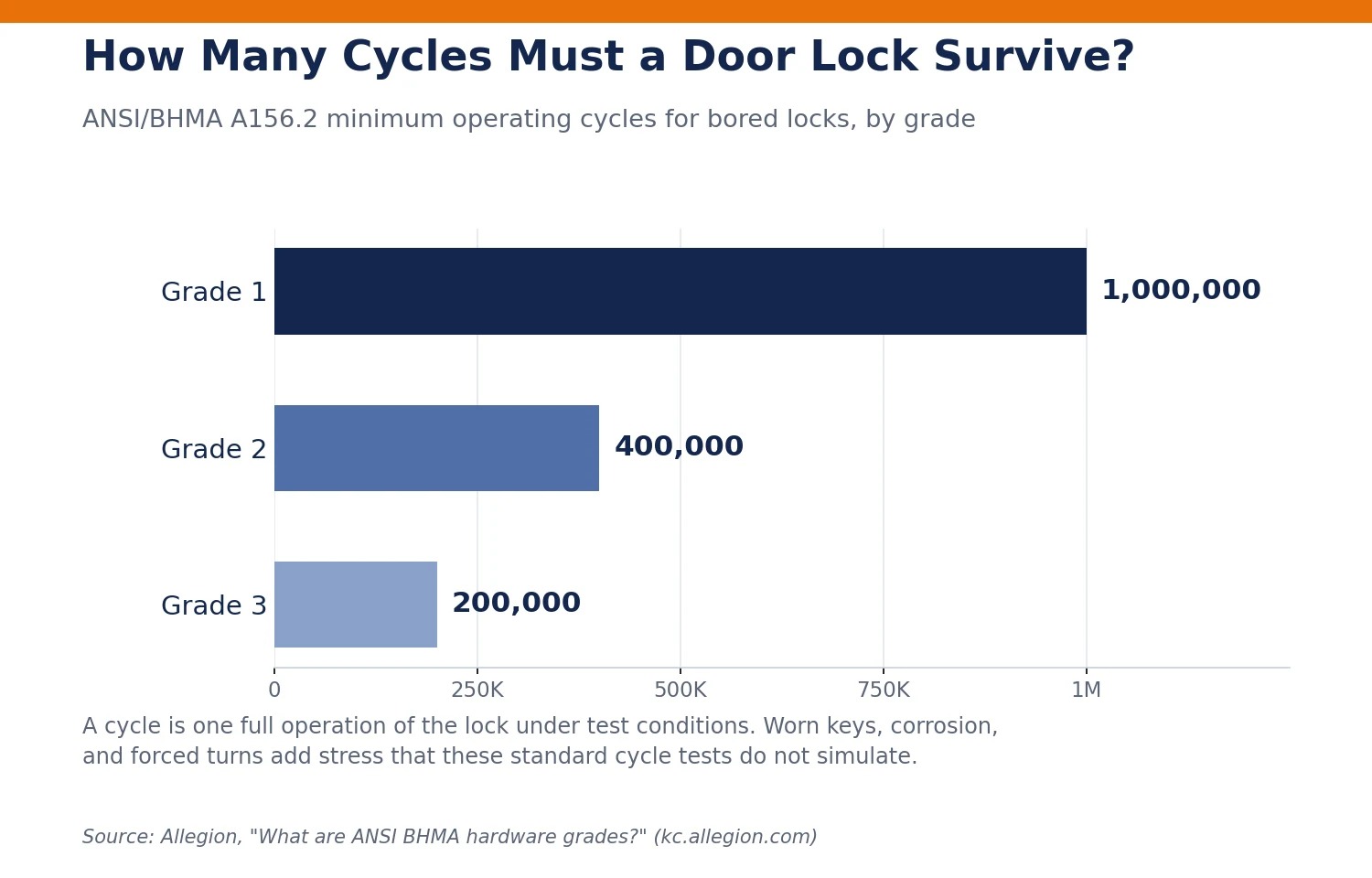
Those numbers describe normal operation in a lab. They do not account for a worn key, corrosion, or repeated forcing, which is why a well-rated lock can still fail early if the key that operates it has seen better days.
Clean and Lubricate the Right Way
Dust, lint, and old residue all add friction. A small amount of dry lock lubricant, applied sparingly, helps a clean cylinder run smoothly. Heavy oils and general-purpose sprays can attract particles and leave a sticky film, so they tend to make a sticking lock worse over time.
Rotate and Retire Keys
- Keep one rarely used spare as a master reference, stored somewhere safe.
- Replace daily-use keys when the teeth start to look rounded.
- Cut new working copies from the reference key or by code rather than from a worn key.
- Check exterior locks at least once a year, especially after storm season.
Worn Key Help from Houston Locksmiths
When a key starts to stick, the best time to act is before it becomes an emergency. Express Locksmith serves Houston, Tomball, Humble, Spring, Cypress, The Woodlands, Conroe, and Sugar Land with key replacement, cylinder service, rekeying, and lockout help. Our technicians who travel to your door bring the equipment needed to cut, test, and install on the spot, so you are not left waiting on a second trip.
If you are not sure whether your problem is the key or the lock, talk with a technician and describe what you are seeing. You can also call (832) 690-1640 to reach the team directly.
What Houston Customers Say
“Aaron was awesome. It took him maybe 10 minutes to program my key fob and cut me a new key. Had me back up and running in no time. Not to mention, he arrived at my house ready to work 30 mins after I called. Highly recommended professional.”
Matt Wilbanks
“My technician Aaron did a fantastic job with replacing my key. He informed me what was wrong with my current key fob and then promptly and professionally made me a replacement. I will recommend Aaron’s services to all my friends and family!”
Jon Boen
“Super friendly and streamlined services. Aaron arrived before his estimated arrival time and handled his business with professionalism. I was very pleased with his business and will recommend to anyone in need. Cheers!”
Zachary Zahn
Frequently Asked Questions About Worn Keys
Can a bent key damage a lock?Yes. A bent key does not sit flush in the keyway, so its cuts cannot line up with the pins the way they should. Forcing it to turn puts uneven sideways pressure on the pins and the plug, and a bend concentrates stress at one point along the blade, which raises the risk that the key snaps off inside the lock. |
What happens if you keep using a worn key?A worn key lifts some pins slightly too high or too low, so the cylinder resists turning. You compensate with jiggling and extra pressure, which grinds the pins against the plug, creates fine metal debris, and speeds up wear on the cylinder. Eventually the key stops working altogether or breaks off in the lock. |
How can I tell if my key is worn out or my lock is failing?Try a spare key that rarely gets used. If the spare turns smoothly, the original key is the problem and the lock is fine. If the spare also sticks, grinds, or needs jiggling, the cylinder has picked up wear, debris, or corrosion and needs professional attention. |
Is it better to replace a worn key or the whole lock?If the spare key still works smoothly, a new key cut from the lock’s specifications is usually all you need. If even a fresh key sticks, the damage is inside the cylinder, and the cylinder should be repaired, re-pinned, or replaced because a new key alone will not fix it. |
What is the difference between copying a key and cutting a key by code?Copying traces the shape of an existing key onto a blank, so any wear in the original carries over to the copy. Cutting by code uses the lock’s factory depth specifications to make a new key from scratch, so it does not inherit the wear of the old blade. |
Can a worn car key damage an ignition?It can. A worn metal car key can catch or drag inside the ignition cylinder, which adds friction and wears the internal parts, much like a worn house key does in a door lock. If your car key sticks, turns roughly, or needs jiggling, have it checked before it fails. |
Does spraying lubricant fix a sticking key?Lubricant can ease friction in a dirty or dry cylinder, but it will not correct a key whose cuts have worn down. A dry lock lubricant helps keep a healthy cylinder clean, while heavy oils and general-purpose sprays can attract lint and dust and leave a gummy residue over time. |
Don’t Wait for a Worn Key to Leave You Locked Out
A sticky key is an early warning, not an emergency, as long as you act on it. The gap between a key that feels a little stiff and a key that snaps off at midnight is narrower than most people expect, and the cost gap between those moments is wide. A quick check today is the easiest way to protect your lock, your key, and your schedule.