


You slide the key in, feel it catch halfway, and wonder if today is the day it snaps off inside the cylinder. That flash of frustration is familiar to anyone dealing with a sticky door lock. The problem tends to get worse over time rather than better on its own, so it should not be ignored. Before attempting a fix, isolate whether the trouble lives in the door frame, the key itself, or inside the lock cylinder.
The instinct to force the key or reach for a can of household spray lubricant is understandable, but both moves often turn a minor maintenance issue into an expensive repair. Forcing a stiff key puts lateral stress on brass that was never designed for it. Spraying the wrong lubricant coats the internal pins with an oily film that attracts grime, and within a few weeks the lock is tighter than before. Getting the diagnosis right first protects both the key and the hardware.
What Causes a Sticky Door Lock?
A sticky lock is rarely a random failure. It is a physical response to something measurable: environmental pressure, gathered debris, mechanical wear, or a combination of the three. Think of a deadbolt as a precise puzzle. Every internal component must align within fractions of a millimeter for the cylinder to rotate freely. When even one piece sits slightly out of position or is coated in grime, the entire mechanism resists.
How Houston Humidity Affects Door Hardware
Climate plays a bigger role than most homeowners expect. In high-humidity regions like Southeast Texas, including greater Houston, Cypress, Spring, and Tomball, wooden doors and frames absorb atmospheric moisture quickly. That absorption causes the wood to swell and press inward against the frame. This movement pushes the latch bolt out of its natural resting position. The lock itself may be in perfect mechanical condition, but the frame has shifted just enough to create constant pressure on the latch. The result is a lock that feels gritty every time the key turns, especially during the wettest months of the year.
Houston’s rainfall pattern makes the pattern easy to see. The wettest stretch runs from late spring through early fall, which lines up almost exactly with the months homeowners report the stiffest locks and the most swollen exterior doors.

Data from NOAA’s Houston/Galveston climate normals show rainfall totals climbing above five inches a month for much of late spring through fall, which is exactly when swelling wood and shifting frames put the most pressure on latch hardware.
The internal side of the problem is separate and worth distinguishing early. Over time, tiny metal shavings shed from brass keys and airborne dust particles settle inside the keyway. These particles work their way down to the pin chambers, where they create friction against the springs and pins that must move freely for the cylinder to turn. The buildup is gradual, which is why a lock that worked fine for years can seem to stiffen almost overnight; the debris has simply reached the point where it obstructs normal pin movement.
The most reliable early diagnostic is what locksmiths call the open door test, covered in detail below. If a thorough inspection turns up nothing you feel comfortable handling yourself, residential locksmith services from a licensed technician can pinpoint the exact cause in minutes rather than hours.
Four Everyday Culprits Behind a Sticky Door Lock
- Debris accumulation: Dust, pollen, and microscopic metal shavings settle inside the keyway over time, clogging the tiny springs that push the pins upward. Once those springs are blocked, the pins cannot reach the shear line no matter how well the key is cut.
- Key wear and tear: Brass is a relatively soft metal. Daily friction gradually wears down the ridges on a key so it no longer lifts the internal pins to the exact height the cylinder requires to turn. A worn key on a clean lock produces the same symptom as a clean key on a dirty lock.
- Structural settling: As a home shifts over time, or as seasonal humidity cycles cause a frame to warp, the strike plate can drift out of alignment with the latch or deadbolt. The door may still close, but the hardware works against itself with every turn.
- Improper prior lubrication: Residue from oil-based products applied in the past binds with airborne dust inside the cylinder, forming a dense, gummy paste that is far more obstructive than the original debris ever was.
If the cause is not obvious after checking these four areas, a technician can run a full diagnostic on-site. Express Locksmith serves homeowners and property managers across Harris and Montgomery Counties, including Spring, Cypress, Tomball, and Houston, with upfront pricing and no surprises. Call 832-690-1640 to schedule a rapid lock inspection.
“Aaron was awesome. It took him maybe 10 mins to program my key fob and cut me a new key. Had me back up and running in no time. Not to mention, he arrived at my house ready to work 30 mins after I called. Highly recommended professional.” – Matt Wilbanks
“Super friendly and streamlined services. Aaron arrived before his estimated arrival time and handled his business with professionalism. I was very pleased with his business and will recommend him to anyone in need. Cheers!” – Zachary Zahn
How to Tell If the Problem Is the Frame or the Cylinder
Before reaching for any tool or lubricant, a thirty-second test tells you which repair path to take. Locksmiths call it the open door test, and it separates a frame alignment issue from a cylinder issue almost instantly.
- Swing the door fully open so the latch bolt has no contact with the strike plate at all.
- Insert the key and try to turn it through a full rotation.
- If it rotates smoothly with no resistance, the problem is almost certainly frame alignment. The latch is binding against the strike plate only when the door is closed.
- If the key still sticks with the door open and the latch completely free, the problem is inside the cylinder itself.
A frame alignment problem is often the simpler fix. Loose hinge screws let a door sag over time, which drops the latch bolt just low enough to scrape against the metal lip of the strike plate instead of sliding cleanly into the recess. Tightening the hinge screws is sometimes the entire repair; other times the strike plate needs to shift slightly to line up with where the latch now rests. A cylinder problem, on the other hand, points toward the cleaning and lubrication process covered next.
Fixing a Stiff Lock Without Damaging It
Cleaning a lock cylinder works on the same principle as cleaning a delicate mechanical keyboard: blasting out the accumulated debris before applying any treatment is not optional. It is the step that determines whether the treatment actually works. Applying lubricant on top of compacted grime just suspends the particles in a slick film and pushes them deeper into the pin chambers. Clear the obstruction first, then lubricate.
- Blow out the keyway with compressed air to clear loose dust and debris before any lubricant goes in. Use two or three short bursts rather than one sustained blast.
- Avoid inserting paperclips, pins, or other metal objects into the keyway to probe for obstructions. The internal springs are delicate and bend easily, which converts a cleaning task into a cylinder replacement.
- Apply a small amount of dry lubricant, such as graphite powder or a PTFE-based spray, directly into the keyhole.
- Insert the key and slide it in and out several times to coat the pin chambers along the full depth of the cylinder.
- Turn the key back and forth at least eight to ten full rotations to distribute the lubricant across every pin and the plug itself.
- Wipe away any excess product from the face of the lock with a clean, dry cloth so it does not attract surface grime.
- If the open door test pointed to frame alignment instead of the cylinder, tighten the loose hinge screws first. This simple adjustment often resolves the binding without touching the lock at all.
Dry Lubricant vs. Oil-Based Products
The difference between a dry lubricant and a wet, oil-based product matters more inside a lock cylinder than almost anywhere else in the home. A wet, oily film inside a keyway is like pouring syrup into a mechanical keyboard: it reduces friction for a short while, then becomes a trap for every particle that passes through the keyway. Standard household spray lubricants such as WD-40 are solvents and water displacers first. They loosen debris and provide brief relief, but the petroleum-based residue left behind collects dust, pollen, and metal shavings. Within weeks, that mixture thickens into a gummy paste that seizes the pins, leaving the lock stickier than it was to start.
| Lubricant Type | How It Performs Inside a Keyway | Recommended for Locks? |
|---|---|---|
| Dry graphite powder | Deposits a dry, slick layer on pins and plug with no residue that attracts debris | Yes |
| PTFE (Teflon) dry spray | Dries almost instantly and leaves a friction-reducing film without collecting grime | Yes |
| WD-40 or general spray oil | Loosens debris short-term, then leaves a wet residue that attracts dust and thickens into paste | Not for long-term use |
| Cooking oil or machine oil | Same wet-residue problem as spray oil, often worse due to viscosity | No |
Dry graphite powder is the traditional choice for lock cylinders and remains reliable for most residential hardware. PTFE-based dry sprays work on the same principle and are widely available at hardware stores. Both are appropriate for standard deadbolts, knob locks, and padlocks. If a key has become the source of the problem rather than the cylinder, a fresh, precisely cut duplicate from a key cutting and duplication service often resolves the stiffness on its own, since a worn key can create the exact same symptom as a dirty lock.
Express Locksmith’s team is available 24/7 and comes directly to your location. Technicians like Aaron and Leon carry the tools to assess and repair stiff locks on-site, without needing a second visit. Call 832-690-1640 to get a technician sent.
“My technician Aaron did a fantastic job with replacing my key. He informed me with what was wrong with my current key fob and then promptly and professionally made me a replacement. I will recommend Aaron’s services to all my friends and family!” – Jon Boen
When Does a Sticking Lock Need Professional Repair?
There is a clear boundary between what maintenance can solve and what it cannot. A worn transmission does not respond to fresh fluid because the gears have physically worn past the point where lubrication changes the outcome. A lock cylinder that has reached the same point will not respond to cleaning and dry lubricant either. Continuing to force the key risks snapping it off inside the mechanism, which turns a simple repair into an emergency extraction.
Signs the Lock Cylinder Is Failing
- The key turns, but the latch does not retract: This points to a broken internal tailpiece or actuator cam, the component that translates the cylinder’s rotation into latch movement. No amount of lubrication repairs a fractured mechanical part.
- The key is physically difficult to insert or withdraw even after cleaning: Bent internal pins or a severely worn cylinder plug create resistance that cleaning cannot resolve. The key may feel as though it is catching on something solid rather than sliding through smoothly.
- The lock cylinder spins in the door without engaging the latch: This means the retaining screws or internal housing clips have broken or backed out entirely, a structural failure that requires cylinder replacement.
- The lock keeps sticking after a thorough cleaning and full dry lubricant application: Persistent resistance after proper maintenance reliably points to physical wear on internal components rather than a debris or lubrication issue.
Hardware quality has a lot to do with how quickly a lock reaches that point. The lock industry rates residential and commercial hardware by mechanical grade, and the difference in expected lifespan between grades is significant.
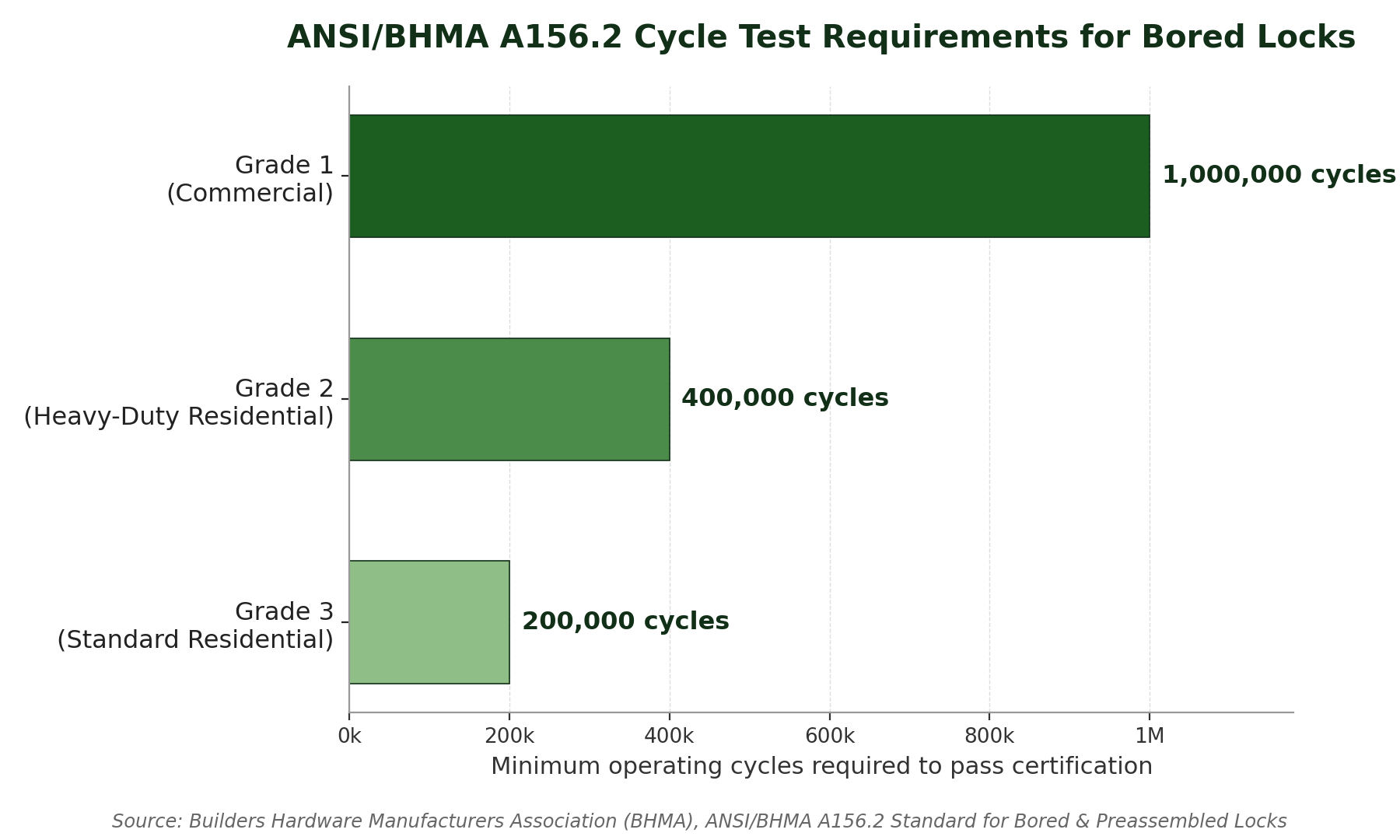
According to the ANSI/BHMA A156.2 hardware standard, a Grade 3 lock, the type most commonly found in production homes, is only rated to survive 200,000 open-and-close cycles before wear becomes expected. A Grade 1 commercial-grade lock is rated for five times that. That gap explains why a builder-grade deadbolt on a busy front door can start sticking within a few years while a heavier-duty lock on the same door frame holds up for a decade or more.
When a lock reaches any of the failure points above, a professional has options that preserve as much of the existing hardware as possible. Rekeying replaces the internal pins while keeping the existing lock housing and current door hardware intact. This is the right call when the cylinder is structurally sound but the key no longer operates smoothly, or when you need to change who holds a working key. Express Locksmith offers a lock rekeying service for residents across the greater Houston area, and current rates are listed on the posted pricing list for full transparency before a technician ever arrives. When the cylinder housing itself is damaged, cracked, or corroded, full cylinder replacement is the appropriate repair, and a technician can often keep the same exterior hardware and door prep in place.
Frequently Asked Questions
Why is my door lock suddenly hard to turn?
A lock that becomes hard to turn without warning is usually responding to one of three things: a sudden shift in frame alignment caused by temperature or humidity changes, a bent or newly worn key, or debris lodged directly between the internal pins. The open door test is the fastest way to separate a frame issue from a cylinder issue. If the key turns freely with the door open, the latch is binding against the strike plate when the door is closed, and tightening the hinge screws or adjusting the strike plate is the starting point. If it still sticks with the door open, the problem is inside the cylinder.
Is WD-40 good for a sticky door lock?
Standard WD-40 is not a reliable long-term fix. It functions primarily as a solvent and water displacer, so it loosens debris and provides brief lubrication, but it leaves behind a wet, petroleum-based residue that collects dust, dirt, and pollen. Over several weeks, that mixture thickens into a gummy paste inside the cylinder that makes the sticking worse than before. It is not catastrophic for a quick, temporary fix, but following it up with a proper cleaning and dry lubricant is necessary to avoid worsening the problem.
What is the best lubricant for a sticky lock?
Dry lubricants are the correct choice for door lock cylinders. Dry graphite powder and PTFE (Teflon) dry sprays both deposit a friction-reducing layer on the internal pins and plug without leaving any wet residue that attracts environmental debris. They dry almost immediately after application, which keeps the cylinder clean between uses. Silicone-based sprays work for some lock types as well, though graphite and PTFE remain the most widely recommended options for standard residential deadbolts and knob locks.
Can a sticking car door lock be fixed the same way as a house lock?
The mechanical principles are similar, but the environment is harsher. Automotive locks contend with road salt, temperature extremes, and moisture infiltration that residential hardware rarely faces. More importantly, many modern car locks incorporate electronic sensors and key fob transponder components close to the cylinder, and heavy graphite powder can interfere with those sensors. A fast-drying, electronic-safe lock cleaner is the safer starting point for a sticky car lock. If the issue persists, an automotive locksmith is the right resource rather than a general-purpose lubricant.
How do I know if my lock needs to be replaced or just rekeyed?
If the lock housing is physically damaged, cracked, corroded, or loose in the door, the hardware should be replaced outright since a structurally compromised cylinder cannot be corrected by rekeying. If the housing is sound and the sticking comes from worn internal pins, or you simply need to change who has a working key, rekeying is the more economical and less disruptive option. A technician removes the existing pins and replaces them with a new set matched to a new key, leaving the exterior hardware, door prep, and finish completely intact.
Get a Sticky Lock Fixed the Right Way
Maintaining physical locks is one of those tasks that tends to get deferred until something goes wrong, and by then the cost and inconvenience are usually higher than they needed to be. A sticky lock caught early, when the key turns but with noticeable resistance, is almost always a cleaning and lubrication job that takes under ten minutes. Left alone, that same resistance leads to a snapped key, a seized cylinder, or a lockout at the worst possible moment.
Homeowners and renters across Houston, Spring, Cypress, Tomball, and the surrounding communities do not have to work through stubborn door hardware alone. Express Locksmith Houston is a family-owned company available 24/7 that comes directly to you with upfront pricing and no surprises. If a lock is still sticking after cleaning and dry lubrication, or you would rather have a professional handle the diagnosis from the start, reach out to schedule a technician at 14106 Stuebner Airline Rd Suite B, or call 832-690-1640 today.