

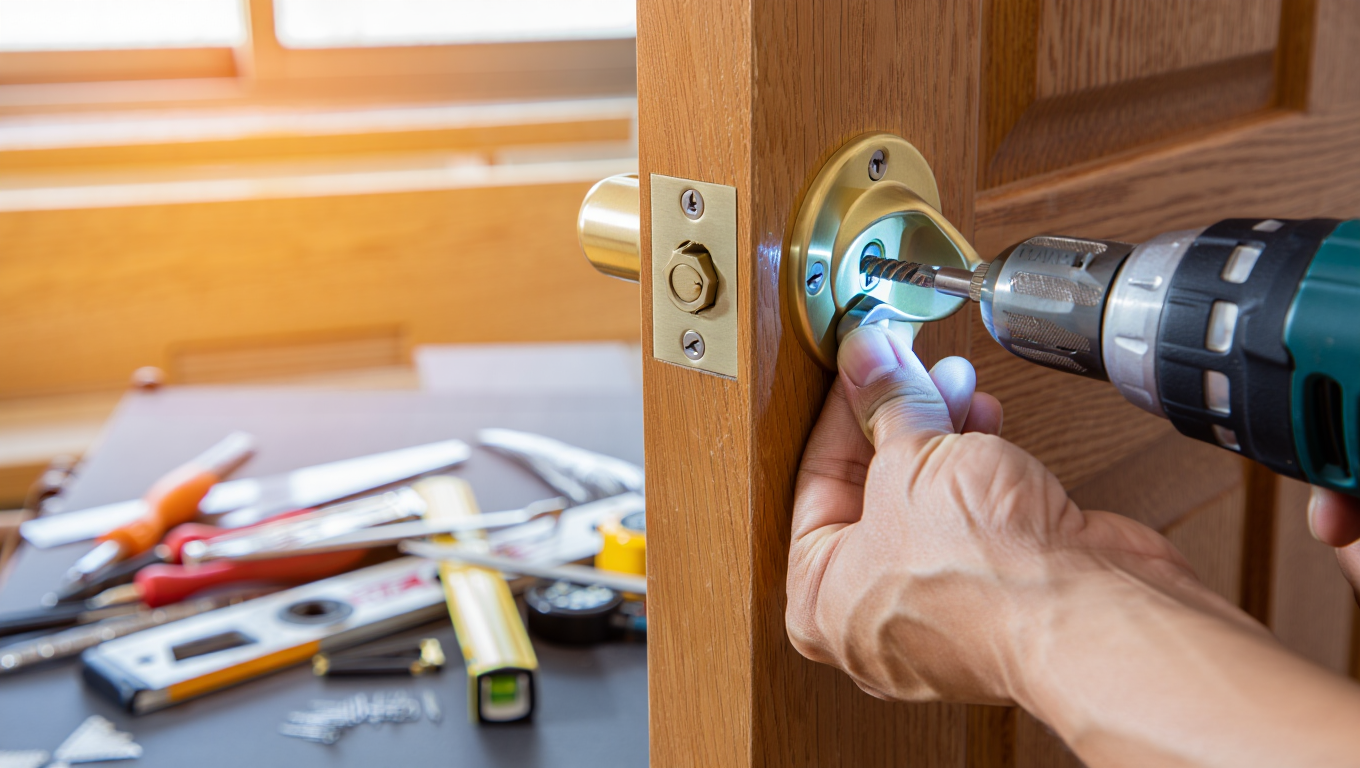
Choosing the wrong door hardware can leave your building exposed to forced entry, and it can also create frustrating bottlenecks that slow down your day. Many property owners use the terms “latch” and “bolt” interchangeably, but that confusion has real consequences. These two mechanisms represent completely distinct designs: one is built for simple passage between rooms, while the other is engineered with hardened steel to withstand heavy physical attacks from a determined intruder. Understanding how a deadbolt vs. latch bolt operates, where each one fails, and how they work together is essential for keeping your property secure.
- Deadbolts offer maximum security with a solid, manually operated steel bolt that extends deep into the door frame.
- Latch bolts prioritize convenience, using a spring-loaded, angled mechanism that automatically secures the door when closed.
- Combined setups deliver the industry standard for exterior doors, balancing daily workflow with reliable security.
Deadbolt vs. Latch Bolt: What Is the Main Difference?
The main difference between a deadbolt vs. latch bolt comes down to how each mechanism resists physical force. A latch bolt features a beveled, angled face and depends entirely on an internal spring to snap into the strike plate the moment the door is pushed shut. No deliberate action is required; the shape does the work. A deadbolt presents a solid, flat-faced steel cylinder that sits completely still until a key or thumbturn is manually rotated to extend or retract it.
That stationary design is precisely what makes a deadbolt secure. Because it has no spring, there is no tension to overcome. An intruder pushing against a thrown deadbolt is pushing against a solid steel rod that is mechanically locked in place, with nothing to compress or manipulate. A residential locksmith can walk through exactly how each internal part interacts when force is applied and confirm whether current hardware meets that standard.
The latch bolt’s vulnerability is structural, not accidental. Its beveled edge is the feature that makes automatic latching possible, but it is also the exact surface an intruder exploits during a shimming attack. A thin, flexible card slipped between the door and frame can push that bevel inward and retract the latch in seconds. Shimming is incredibly common, and no complex tools, noise, or skill are required to pull it off.
Understanding a Lock’s Anatomy
Three clear differences separate these mechanisms at the component level. Size matters for security:
- Bolt shape: Latch bolts feature a beveled edge to enable automatic latching. Deadbolts present a completely square, flat-faced steel cylinder that maximizes surface contact inside the strike plate, eliminating any angle an intruder could exploit with a tool.
- Throw length: A standard latch bolt extends only 0.5 inches into the strike plate. That’s adequate for keeping a door closed against wind, but it offers minimal resistance against a shoulder or kick. A properly installed deadbolt extends a full 1.0 inch into the door frame, anchoring the door directly into the surrounding wall studs.
- Operation: Latch bolts retract when a doorknob or lever handle is turned. Deadbolts require a deliberate, separate action, since a key or thumbturn must be turned every single time.
How Deadbolts and Spring Latches Work
A spring latch operates through a spindle and spring assembly built for convenience. Turning the handle rotates the spindle, which retracts the latch against spring tension. Release the handle, and the spring immediately drives the latch back out. Close the door, and the beveled face rides against the strike plate lip, compresses inward, then snaps into the strike hole once the door seats fully. The whole process is automatic and requires less than 4.5 pounds of force to complete. That’s exactly why it works so well for high-traffic passage, and exactly why it fails as a standalone security device.
A deadbolt’s lock mechanism works on an entirely different principle. Turning the key or thumbturn rotates a cam inside the lock case, and that cam drives a flat connecting bar called a tailpiece, which physically slides the solid steel bolt forward through the door edge and deep into the reinforced strike plate mortise. No spring is involved at any stage, and the bolt stays extended until it’s deliberately retracted. That absence of spring tension is what makes forced retraction mechanically impossible without destroying the hardware itself.
Exploring Deadbolt Types and Hybrids
Not all deadbolts are identical, and the distinctions matter depending on the door’s location and the occupant’s safety priorities:
- Single-cylinder deadbolts: Feature a keyway on the exterior and a thumbturn on the interior. This is the most common residential configuration, and for good reason: during a fire or emergency, occupants can exit without searching for a key.
- Double-cylinder deadbolts: Require a key on both sides. They prevent an intruder from shattering a nearby glass panel and reaching inside to turn a thumbturn. However, fire marshals often warn against them as a safety hazard in homes because they can trap occupants during an emergency. Safety should come first.
- Deadlatches (the hybrid option): A spring latch fitted with a small secondary guard bolt, or plunger, positioned beside the main latch. When the door closes, the strike plate depresses this plunger, which mechanically immobilizes the main latch against shimming attacks. A deadlatch won’t match a true deadbolt’s throw depth or static load capacity, but it’s a solid upgrade over a standard spring latch on secondary entry doors.
For a detailed breakdown of which configurations offer the strongest residential protection, a technician handling lock changes and rekeying can walk through grade ratings, brand comparisons, and installation considerations specific to a given door.
Which Lock Type Is Better for Security?
A deadbolt is always the superior choice for security, because standard spring latches are very vulnerable to shimming, a technique often called “loiding” in the locksmith trade. An intruder works a thin, flexible card between the door and frame to push the beveled latch backward. This requires no specialized tools, leaves no visible damage, and takes very little time. A deadbolt resists this entirely because its flat face offers no exploitable geometry, and its lock mechanism holds the steel rod in place without any spring tension to overcome.
The time difference between these two hardware types under real-world attack conditions is stark. According to a Virginia State Crime Commission report, a standard key-in-knob spring latch can be bypassed in as little as 5 to 10 seconds, whereas a properly installed deadbolt raises the average forced-entry time to roughly 4 minutes. That gap matters because most burglars abandon an attempt that takes too long or makes too much noise. FBI data reinforces the stakes: 34% of burglars enter through the front door, which makes front door lock choice the single most important security decision on any property.
Deadbolt vs. Latch Bolt Industry Standards and Strength Ratings
The ANSI/BHMA A156.36 standard for auxiliary hardware and the ANSI/BHMA A156.2 standard for bored locks and latches set the testing rules that separate marketing claims from verified performance. Ratings prove real strength:
- A Grade 1 deadbolt must withstand 10 hammer blows and a static door-strike force of 1,350 pounds of force. This is the standard for commercial entryways and high-risk residential applications.
- A Grade 2 deadbolt must withstand 5 hammer blows and 1,125 pounds of force, making it appropriate for most residential front doors.
- A Grade 3 deadbolt must withstand 2 hammer blows and 675 pounds of force, the minimum acceptable threshold, suitable only for low-risk secondary doors.
- Under ANSI/BHMA A156.2, a latch bolt must withstand a minimum static load of 800 pounds of force in a standard latch strength test. That figure sounds substantial until it’s compared to a Grade 1 deadbolt’s 1,350-pound rating, a 41% gap in structural resistance.
Before committing to a hardware specification, it’s worth evaluating whether upgrading to high security locks makes financial and practical sense for a specific security risk profile and budget.
“A latch bolt is designed to keep a door closed; a deadbolt is designed to keep intruders out. Relying solely on a spring latch for exterior security is one of the most common vulnerabilities in property management.”
Secure your property with professional-grade hardware. A licensed locksmith can assess entryways and install heavy-duty, ANSI-graded deadbolts. Call Express Locksmith today at (832) 690-1640 for rapid, reliable service.
Key Differences in Locking Strength and Convenience
The trade-off between these two hardware types is genuine, not manufactured. Latch bolts lock automatically when the door shuts, so an entry point is never left standing open just because the hardware wasn’t manually engaged. That automatic closure is highly useful in high-traffic commercial environments where dozens of people move through a door each hour. The cost is security: the same spring that makes automatic latching possible is the mechanism an intruder exploits.
Deadbolts demand deliberate action. Every entry and exit requires a key or thumbturn every single time. That discipline requirement is a friction point for some users, particularly in multi-tenant or high-frequency access environments. But the physical load capacity difference is not marginal. A Grade 1 deadbolt withstands up to 1,350 pounds of static force, while a standard latch bolt’s 800-pound rating fails well before that threshold when subjected to a determined kick or shoulder strike, leaving an entryway vulnerable to forced entry.
Bridging the Gap with Smart Technology
Modern smart deadbolt systems have mostly closed the usability gap between these two hardware categories. Rather than forcing a choice between security and convenience, motorized deadbolts with auto-lock timers deliver both. The bolt throws automatically after a configurable delay once the door closes, and keyless entry via PIN pad, fingerprint reader, or smartphone app eliminates the fumbling-for-keys friction entirely. Devices like the Schlage Encode Smart Wi-Fi Deadbolt and the Schlage Encode Plus Smart Wi-Fi Deadbolt integrate directly with major smart home ecosystems, while Kwikset smart lock options offer comparable functionality at varied price points.
The market has responded accordingly. According to Fortune Business Insights, deadbolt smart locks represent approximately 35% of the smart lock market in 2026, driven largely by Matter and Thread protocol integration that enables reliable connectivity across smart home platforms. That adoption rate reflects a real shift in how property owners think about the security-convenience trade-off, and access logs, remote management, and temporary credential issuance all change the operational calculus for property managers considering an upgrade.
When a Deadbolt vs. Latch Bolt Setup Makes Sense
Door location is the main factor. Interior passage doors, such as closets, hallways, conference rooms, and public restrooms, have no security requirement. They need to close reliably, allow quick keyless passage, and handle high cycle counts without mechanical fatigue. A latch bolt is purpose-built for exactly that application, and forcing a deadbolt onto an interior door creates unnecessary friction and adds cost without any security benefit.
Exterior entry points are a different calculation entirely. A front door lock, back doors, side entries, and the door connecting a garage to living space all require a deadbolt. A spring latch alone on any of these openings is a security risk, not a true lock.
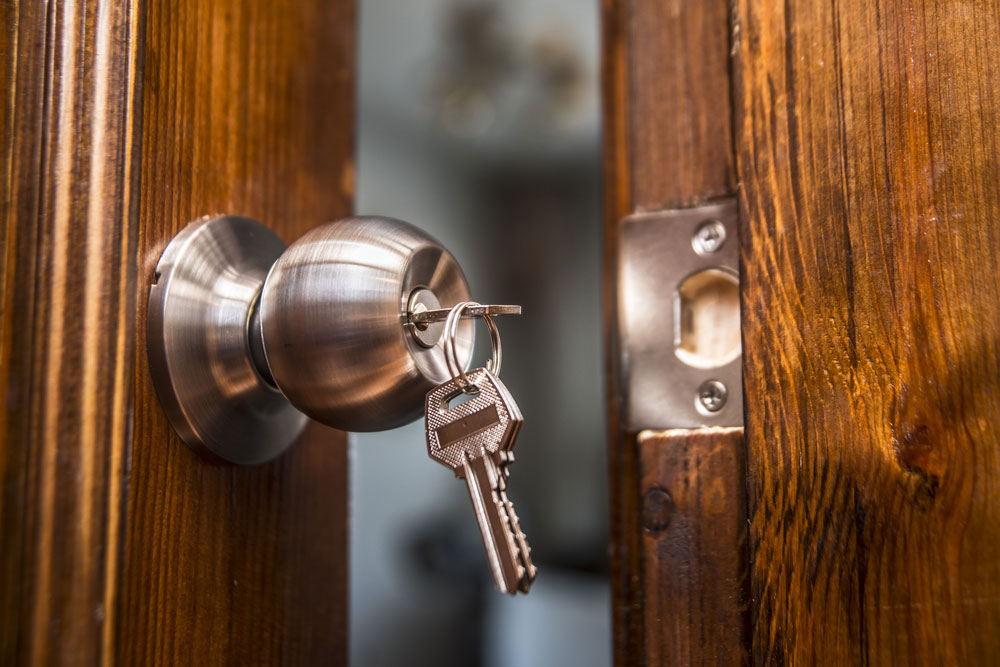
High-traffic commercial areas present a nuanced case. Office doors, conference rooms, and shared workspaces see dozens of entries per hour and require ADA-compliant lever hardware for accessibility. In these settings, a latch-only setup with a keyed lever handle is often the correct specification, since smooth traffic flow and compliance take priority over the forced-entry resistance that a deadbolt provides on a primary perimeter door.
Whether the need is a residential front door or an entire commercial facility that requires ADA-compliant leversets, Express Locksmith stocks a wide range of Grade 1 and Grade 2 hardware from top brands like Schlage and Kwikset, and technicians are available 24/7 across the Greater Houston area.
How to Choose the Right Door Hardware
Commercial properties often face this decision across dozens of doors at once, and a commercial locksmith can help standardize hardware specs across an entire building rather than handling each door as a one-off. A simple decision guide covers most scenarios:
- Assess the door’s location first. Any door that opens to the exterior or controls access to a secured interior zone, like a home office, server room, or storage area with sensitive inventory, needs a deadbolt. Strictly interior doors with no security requirement can rely on a latch bolt.
- Verify the frame before specifying the lock. A Grade 1 deadbolt installed in a soft pine frame with a lightweight strike plate secured by ¾-inch screws is not a Grade 1 installation. Reinforce exterior frames with a heavy-duty strike plate and 3-inch screws that reach past the door casing and seat into the wall studs. The frame is the system.
- Check for ANSI/BHMA certification on the packaging before purchasing. For exterior doors, target Grade 1 or Grade 2 deadbolts paired with a Grade 2 keyed entry latch. Grade 3 hardware is the minimum residential standard, not the target.
- Consider smart integration if occupant behavior is a known variable. An auto-lock sensor on a smart deadbolt eliminates the “did I lock it?” problem entirely, since the bolt throws automatically after a set interval and the app confirms status remotely.
For anyone unsure which grade or configuration fits a specific door, a mobile locksmith can inspect the hardware on-site and make the call without requiring a shop visit.
Understanding BHMA Lock Grades and Performance Standards
The ANSI/BHMA grading system is the official standard for evaluating lock hardware in North America. Three grades define the performance spectrum:
| Grade | Hammer Blows | Static Force | Latch Cycle Rating | Typical Use |
|---|---|---|---|---|
| Grade 1 | 10 blows | 1,350 lbs | 1,000,000 cycles | Commercial entryways, high-risk residential |
| Grade 2 | 5 blows | 1,125 lbs | 800,000 cycles | Most residential front doors, light commercial |
| Grade 3 | 2 blows | 675 lbs | 200,000 cycles | Low-risk interior, secondary residential entries |
The cycle count requirements deserve attention because they reflect a real-world failure mode that static force tests don’t capture: spring fatigue. A latch bolt spring that handles 200,000 cycles before potential failure behaves very differently from one rated to 1,000,000. In a rental property with multiple tenants cycling through a door daily, that gap in durability translates directly into frequent maintenance visits, higher replacement costs, and potential security gaps.
The Professional Standard: Combining Both Systems
The combined setup, consisting of a latch bolt in the lever or knob assembly paired with a deadbolt mounted above it, is the common practice for exterior doors. The reasoning is straightforward. The latch bolt handles the door’s daily mechanical function, keeping it closed against weather stripping, preventing drafts, and seating the door firmly in the frame during normal use. The auxiliary deadbolt handles the security function, providing the primary physical barrier against forced entry that the latch bolt cannot deliver on its own.
Neither component is redundant. Remove the latch bolt, and the door rattles in the frame, weather sealing degrades, and the deadbolt carries mechanical stress it was not designed to absorb. Remove the deadbolt, and there’s a door that closes reliably but can be shimmed open in seconds. The combination is the standard precisely because each component does something the other cannot.
The double-cylinder debate is worth acknowledging honestly. Double-cylinder deadbolts offer a genuine security advantage on doors with adjacent glass panels, since an intruder who shatters the glass cannot simply reach in and turn a thumbturn. But fire safety organizations and most residential building codes in Texas discourage or restrict their use in sleeping areas because they require a key to exit, which can trap occupants during a fire. For most residential applications, a single-cylinder deadbolt paired with a quality latch bolt is the correct setup. Double-cylinder configurations belong on specific commercial or high-risk residential doors where the glass-panel vulnerability is real, and the occupancy pattern allows for safe key management without violating local life-safety codes.
Property managers overseeing several units at once may also want to review master key systems, which let a single credential open designated doors across a property without compromising individual unit security.
Frequently Asked Questions About Deadbolts and Latches
Can a deadbolt be shimmed like a latch bolt?
No. Shimming depends on the angled bevel of a spring-loaded latch, since it requires a surface to push against and a spring to compress. A deadbolt’s flat, square face offers no exploitable angle, and its lock mechanism holds the steel rod in place without any spring tension. Applying end pressure to a thrown deadbolt accomplishes nothing except confirming it’s engaged.
What is a deadlatch, and is it as secure as a deadbolt?
A deadlatch is a spring latch fitted with a small secondary guard bolt, a plunger positioned beside the main latch body. When the door closes, the strike plate depresses this plunger, mechanically immobilizing the main latch and blocking shimming attacks. It’s a solid upgrade over a standard spring latch, but it still cannot match a deadbolt’s 1-inch throw depth, its static load rating, or its resistance to frame-warping misalignment over time.
Do I need both a deadbolt and a latch bolt on my front door?
Yes. The latch bolt keeps the door closed and maintains the weather seal during daily use, while the deadbolt provides the primary security barrier against forced entry. Each component handles a function that the other isn’t designed for, so using both gives the correct balance of daily convenience and physical security.
Can a standard latch bolt door be converted into a deadbolt door?
Yes. Adding a deadbolt to a door that currently has only a latch bolt is a standard installation locksmiths call “boring a door.” It requires drilling a 2-1/8 inch hole through the door face and a 1-inch hole into the door edge for the bolt. Many technicians use a deadbolt installation template to ensure alignment, and hiring a professional locksmith eliminates the risk of a misaligned strike plate that prevents the bolt from throwing fully.
Are deadbolts required by insurance companies for commercial properties?
Many commercial property insurance policies do mandate ANSI Grade 1 or Grade 2 deadbolts on all exterior doors as a coverage condition. The reasoning is actuarial, since deadbolts measurably reduce successful forced-entry events, which reduces claim frequency. It’s worth reviewing policy language before specifying hardware on a commercial project, since the grade requirement may already be written into coverage terms.
Reach Out to Express Locksmith for a Quote Today
For homeowners and property managers across the Greater Houston area, including Houston, Spring, Conroe, The Woodlands, Tomball, Cypress, and Sugar Land, local regulations and weather patterns shape door hardware decisions in ways that generic guides don’t address. Under the Texas Property Code, Section 92.153, landlords of residential rental properties must equip all exterior doors with specific security devices without waiting for a tenant request. That includes a keyless deadbolt and a door latch on every exterior door, and tenants in Aldine, Humble, Atascocita, and League City are entitled to that hardware as a baseline, not an upgrade.
The coastal climate of Southeast Texas adds a layer of complexity. High humidity and extreme summer heat in cities like Baytown, Dayton, and Brookshire cause wooden doors and frames to swell, warp, and contract with the seasons. That movement can gradually misalign a strike plate until a deadbolt no longer throws fully, or a spring latch fails to engage at all. Locksmiths working in Magnolia, New Caney, and Jersey Village routinely recommend heavy-duty adjustable strike plates, the kind that allow minor repositioning without a full reinstallation, alongside Grade 1 or Grade 2 hardware rated to hold up through those weather patterns.
Take a walk around the property today and inspect every exterior door. Confirm that each entry point has a functioning, ANSI/BHMA graded deadbolt with at least a 1-inch throw, and check that the strike plates are secured with 3-inch screws. Any exterior door relying solely on a spring latch is a priority upgrade, whether the fix is a traditional deadbolt or a smart lock that auto-throws after the door closes.
Don’t leave a property exposed to simple bypass attacks. Contact Express Locksmith today to speak with a licensed technician, get an upfront quote, and schedule professional lock installation anywhere in the Greater Houston area. Call (832) 690-1640: technicians are available 24/7.